
Quantum Metrology Startup Emerges
EuQlid, a startup that is developing next-generation quantum-based metrology tools, has emerged

By Mark LaPedus
EuQlid, a startup that is developing next-generation quantum-based metrology tools, has emerged from stealth mode.
EuQlid has raised $3 million in funding from lead investor QDNL Participations, with participation from Quantonation, and over $1.5 million in early customer revenue.
Based in College Park, Md., the company has already delivered its first-generation product—a Quantum Diamond Microscope (QDM). The QDM is based on the company’s next-generation quantum sensing technology.
The QDM itself is designed for use in geoscience and bioimaging applications. The system has been delivered and is in use at Harvard University, New York University, Oxford University, Curtin University and others.
The QDM incorporates EuQlid’s proprietary quantum imaging platform. This technology, called Qu-MRI, enables non-destructive mapping of buried current flow with precision inside complex materials and devices. The technology is a 3D imaging solution for a range of applications.
In fact, the company plans to leverage its Qu-MRI technology and expand its product portfolio. It is targeting the semiconductor and battery markets.
“Qu-MRI is a core technology platform that is configured to end-system needs,” said Sanjive Agarwala, chief executive and co-founder of EuQlid, in an e-mail exchange. “QDM is a product in which Qu-MRI is integrated to target a specific market. Our first QDM product in the market is targeted for geoscience, bioimaging and materials characterization applications. We are in the process of expanding our product portfolio into semiconductor and battery applications.”
The company’s quantum-based technology could address a critical gap in the market. The Qu-MRI platform combines quantum magnetometry with advanced signal processing and machine learning to deliver buried electrical current maps with high-throughput and nano-amp sensitivity, without physical contact or destructive cross-sectioning.
For this, EuQlid is harnessing the power of quantum defects in diamonds. “The core sensing element of the EuQlid system is a diamond chip, surface-implanted with nitrogen-vacancy (NV) color centers. NV centers in diamond are a leading modality for sensitive, high-spatial-resolution, wide-field-of-view imaging of microscopic magnetic fields. It is probed via optical and microwave pulse sequences, converting vector magnetic field information into fluorescence that is read out on a photodetector. Using advanced signal processing algorithms, the vector magnetic fields are reconstructed into subsurface current distributions in materials and devices,” Agarwala said.
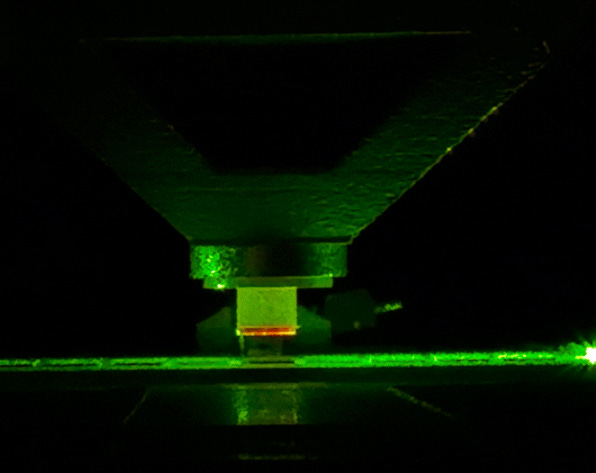
EuQlid’s Qu-MRI uses Quantum NV-diamond magnetometry to deliver buried electrical current maps. Source: Company
EuQlid’s technology is promising, especially for metrology applications in the semiconductor industry. “EuQlid’s Qu-MRI addresses a foundational technology need for the design and manufacturing of next-generation semiconductors, by non-invasively visualizing buried connectivity defects,” said Paul van der Heide, director of materials and component analysis at Imec, a Belgium-based R&D organization.
EuQlid was founded by Ronald Walsworth, David Glenn and Agarwala. Prior to EuQlid, Agarwala was corporate vice president and general manager of the IP Group at Cadence.
Glenn is the chief technology officer at EuQlid. Walsworth is a professor in the Department of Electrical & Computer Engineering and Department of Physics at the University of Maryland. Walsworth is also the founding director of the Quantum Technology Center (QTC) at the University of Maryland.
Quantum technology is a broad field. The main fields of quantum technology are quantum computing, quantum communication and quantum sensing.