

By Mark LaPedus
Fueled by AI and other technologies, the semiconductor equipment industry has experienced strong growth in 2025.
And based on the current projections, 2026 looks relatively bright. But there are also several challenges and unknowns looming on the horizon.
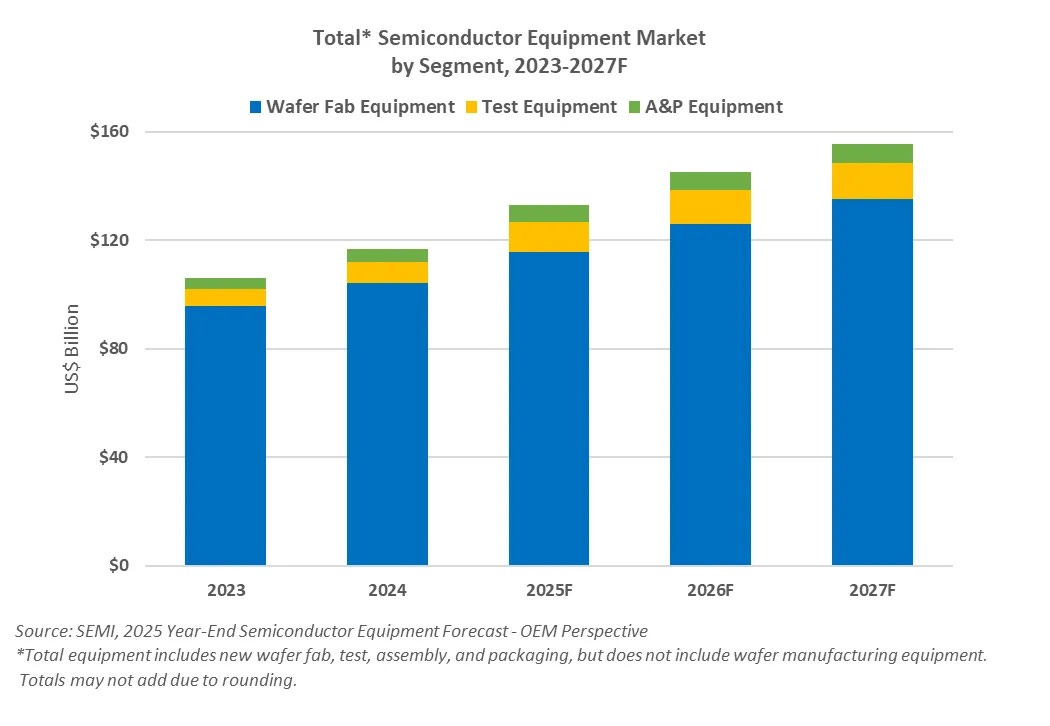
Global sales of total semiconductor manufacturing equipment by original equipment manufacturers (OEMs) are forecast to reach a record high of $133 billion in 2025, growing 13.7% year-on-year, according to SEMI, a trade group.
Then, the growth is expected to moderate. In 2026, the total semiconductor equipment market is expected to reach $145 billion in sales, up 9% over 2025, according to SEMI. Then, in 2027, the market is expected to reach $156 billion, up 7.6% over 2026, according to SEMI (See chart below).
The overall growth will be driven by investments related to AI, particularly in leading-edge logic and memory. The adoption of advanced packaging will also fuel the growth.
“Global semiconductor equipment sales show robust momentum, with both the front-end and back-end segments projected to see three consecutive years of growth, culminating in total sales surpassing $150 billion for the first time in 2027,” said Ajit Manocha, SEMI’s president and chief executive. “Investments to support AI demand have been stronger than anticipated since our midyear forecast, leading us to boost the outlook for all segments.”
Source: SEMI
The state of the equipment business reflects the general health of the overall semiconductor industry. Generally, the semiconductor business is a mixed picture. The AI-related chip markets are robust. The non-AI chip segments, such as automotive, communications, consumer and industrial, are recovering from a downturn.
As reported, the World Semiconductor Trade Statistics (WSTS) organization recently raised its growth outlook for the semiconductor industry in both 2025 and 2026. The global semiconductor market is projected to grow by 22% in 2025, reaching $772 billion in terms of sales, according to the WSTS. For 2026, WSTS forecasts the global semiconductor market to grow by more than 25%, reaching $975 billion.
Still, there are several challenges and unknowns here. TSMC and a few others are expected to increase their capital spending budgets in 2026. Intel, which is struggling, will likely decrease its capital spending for 2026.
As before, geopolitical issues, trade policies and other factors could impact the semiconductor and fab equipment markets. Export control policies play a big role for equipment makers.
The big unknown—or perhaps the spoiler—is the memory market. In recent times, prices for memory products have increased. There are also shortages of select memory products in the market. Memory prices are likely to rise 30% in Q4 2025 and possibly 20% more early next year, on top of 50% price increases experienced year to date, according to Counterpoint Research.
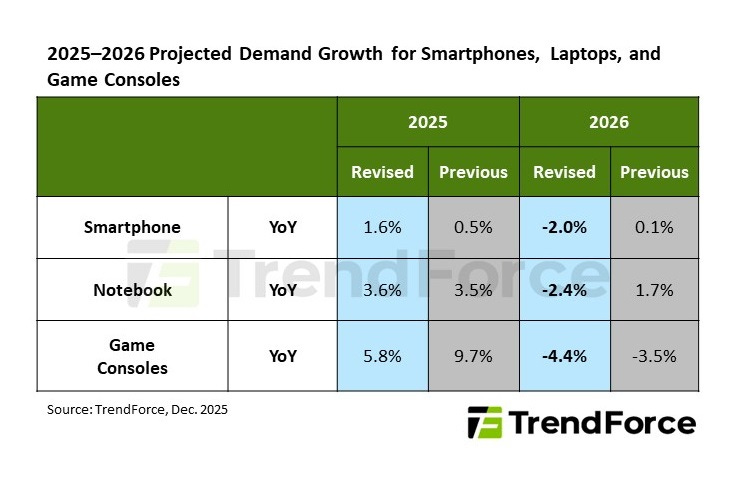
Rising memory prices have increased the bill-of-material costs for various electronic products. This in turn has caused select companies to hike their prices, which in turn could dampen market demand, according to TrendForce, a research firm. After reducing its 2026 shipment forecasts for smartphones and laptops in November, TrendForce also recently downgraded its 2026 forecast for game console shipments.
Equipment sales by segment
For now, though, the semiconductor equipment industry expects to see growth in 2026 and beyond. For example, the wafer fab equipment (WFE) segment, which includes wafer processing, mask/reticle and fab facilities equipment, is expected to grow.
After registering a record $104 billion in sales last year, the WFE segment is projected to grow by 11.0% to $115.7 billion in 2025, according to SEMI. This represents an upward revision from the previous forecast of $110.8 billion, “reflecting stronger than expected investments in DRAM and high-bandwidth memory (HBM) to support AI computing,” according to SEMI.
Looking ahead, WFE segment sales are projected to expand 9.0% in 2026 and 7.3% in 2027, reaching $135.2 billion as device makers increase spending on advanced logic and memory technologies, according to the trade group.
The back-end equipment segment is anticipated to continue its strong recovery that began in 2024. Sales of semiconductor test equipment are projected to surge 48.1% to $11.2 billion in 2025, while assembly and packaging (A&P) equipment sales are projected to rise by 19.6% to $6.4 billion, according to SEMI.
Back-end growth is expected to continue, with test equipment sales growing 12.0% in 2026 and 7.1% in 2027, and A&P sales are forecast to grow 9.2% in 2026 and 6.9% in 2027, according to SEMI.
“This expansion is underpinned by the growing complexity of device architectures, accelerated adoption of advanced and heterogeneous packaging, and stringent performance requirements for AI and HBM semiconductors,” according to SEMI. “These drivers are partly offset by ongoing softness in consumer, automotive and industrial demand, which continues to weigh on some mainstream test and packaging segments.”
WFE sales by application
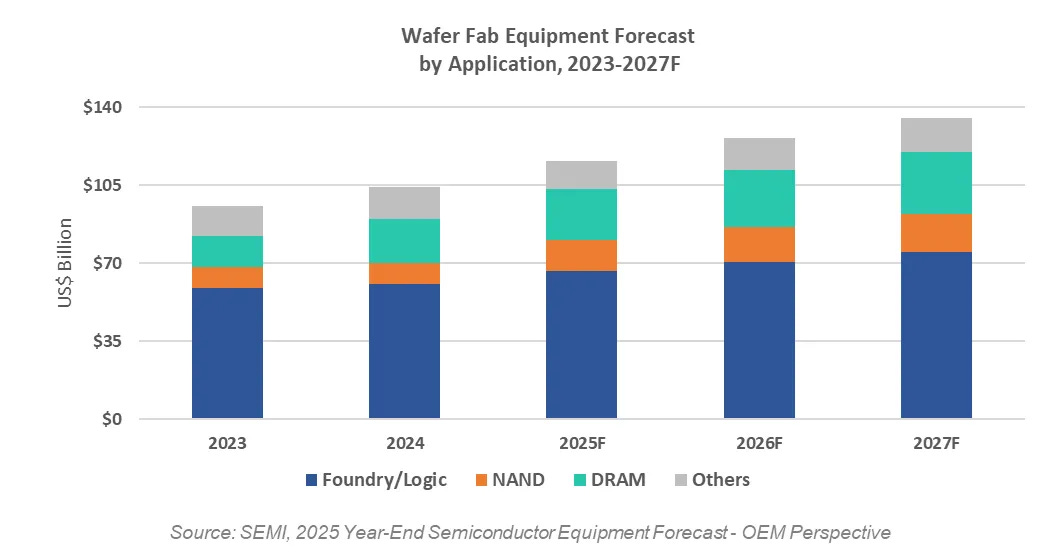
Meanwhile, WFE sales for foundry and logic applications are expected to show 9.8% year-over-year growth to $66.6 billion in 2025, supported by spending for advanced nodes, according to SEMI.
The segment is forecast to see 5.5% growth in 2026 and 6.9% increase to $75.2 billion in 2027, according to SEMI. “Investments will increasingly target leading-edge technologies as the industry moves toward high-volume manufacturing at the 2nm gate-all-around (GAA) node,” according to SEMI.
Memory-related capital expenditures are projected to see significant expansion through 2027. The NAND equipment market is expected to see growth of 45.4% to $14.0 billion in 2025 and further increase 12.7% to $15.7 billion in 2026 and 7.3% to $16.9 billion in 2027, according to SEMI.
The growth is driven by advancements in 3D NAND stacking and capacity expansion at both leading and mainstream layers.
DRAM equipment sales are projected to rise 15.4% to $22.5 billion in 2025, followed by 15.1% and 7.8% year-on-year growth in 2026 and 2027, respectively, according to SEMI. The growth is fueled by the continued ramp of HBM and DDR5 DRAM.
Source: SEMI
Equipment sales by region
China, Taiwan and Korea are expected to remain the top three destinations for equipment spending through 2027. “China is projected to maintain the leading position over the forecast period as domestic chipmakers continue to invest in both mature and select advanced nodes, even as growth moderates and sales gradually decline from 2026,” according to SEMI.
In Taiwan, robust 2025 spending reflects large-scale leading-edge capacity builds for AI and high-performance computing. Korea’s equipment outlays are supported by investments in advanced memory technologies, including HBM. All other regions tracked are expected to see an equipment spending increase in 2026 and 2027.
The SEMI forecast is based on the collective input from top equipment suppliers, the SEMI Worldwide Semiconductor Equipment Market Statistics (WWSEMS) data collection program, and the SEMI World Fab Forecast database.
The WSTS is an independent non-profit organization representing the vast majority of the world semiconductor industry. The organization is the industry’s only source for monthly shipment statistics.